
Change is the essence of life. Change is evolution. Change is our story.
But resistance to change stops growth in its tracks…
Until that energy is harnessed and turned into ownership for shared renewal.
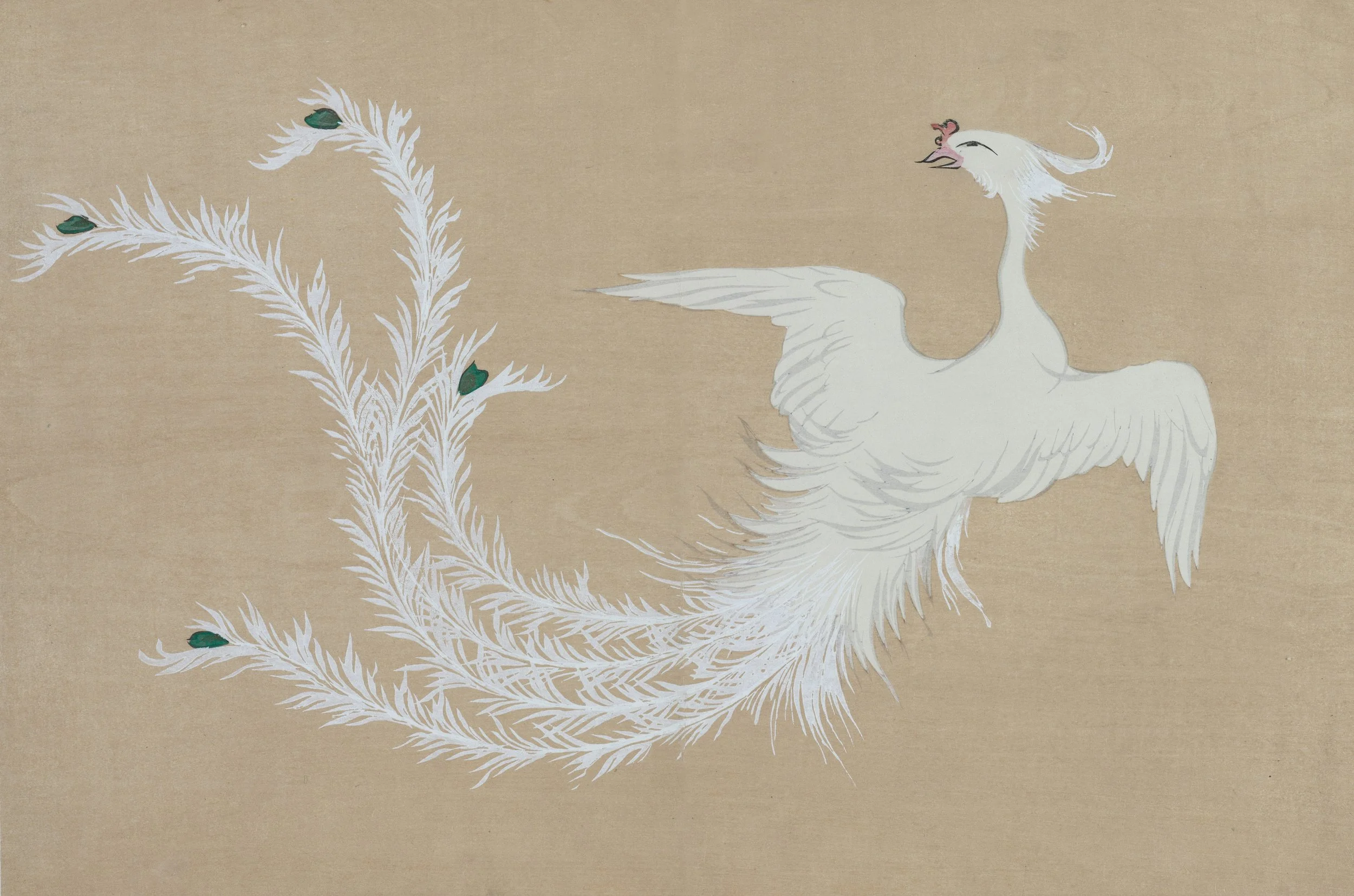
Sekka, Kamisaka. Flowers of a Hundred Worlds (Momoyogusa): White Phoenix (Hakuho). 1909–10. Woodblock print. Cleveland Museum of Art.
Most creative writing advice will tell us that it is conflict that creates drama. No friction, no progress.
But the fabulous fantasy and science-fiction writer Ursula K. Le Guin postulated that “change” isn’t just an appropriate alternative, but the essence of the transformative power dramatic conflict tries to conjure.
After all, what conflict is meant to create in a story is a pivot point: Change.
And change can happen through incentives other than friction.
Change and conflict may seem to describe two different concepts, but consider that even though change is a positive factor of natural growth, it is the growing pain we feel uncomfortable with. Sometimes, it hurts so bad, we avoid change altogether.
When I began to transfer the intricacies of change and conflict from film screenwriting to business culture transformation, I stumbled into one of the biggest problems senior leaders face:
How do you innovate anything when your people resist change?
While both executives and employees usually want to advance together in the best ways possible, change itself can become the biggest obstacle to the success of an organisation.
If resistance doesn’t stem from conscious unwillingness to change, it must be rooted in something else. Something deeper.
“Organisational change meets resistance when teams feel protective of a status quo they deem necessary to function.”
About the Psychology of Resistance
Fear. Shadowy with teeth and claws. Change can feel like a threat.
Human beings have emotions. We react to the raw data we encounter. And something as primal as a perceived attack might just set us off.
When we feel protective of something, we push back when someone tries to mess with it.
Chances are that the team already took small steps to make the work culture better, long before any intervention. The employees were on the ground all along and did the best they could with the tools they had.
Organisational change meets resistance when teams feel protective of a status quo they deem necessary to function. That could be:
a work process
an informal social dynamic
a formal hierarchy
a system that combines any of the above into critical dependencies.
It is important to note that all of those are internal factors. External factors may relate to economic uncertainty or personal circumstances. But in both cases, change introduces a sudden unpredictability.
People don’t resist the new idea; they protect their sense of control.
“WHAT provides a sense of safety?
WHY do people need this behavioural safety net?
WHEN would another behaviour feel safe instead?”
How To Get Buy-In for Organisational Change
People need to feel seen: resistance is a symptom of a larger context of work culture that the team has insights into.
Getting buy-in for change requires that this insight is acknowledged, integrated, and valued.
Instead of telling people what the work culture should be, they need to be invited to co-create it with the organisational intelligence they bring to the table.
Leaders who want to change work culture for the better do so for the right reasons, but the way they approach the topic will create buy-in or resistance from the get-go.
Leaders who answer the following three questions can make culture innovation stick:
WHAT provides a sense of safety?
WHY do people need this behavioural safety net?
WHEN would another behaviour feel safe instead?
Every positive change takes people into account, and where they are before, during, and after the transformation.
It is the subconscious story that drives or hinders transformation.
“Positive change harnesses conflict and turns the friction into learning potential for renewal that serves everyone.”
From Resistance to Renewal
Successful change doesn’t eliminate conflict. It uses it.
Conflict, such as resistance, requires a lot of energy. The fact that people put their feet down and protect their ways of operating costs them time, effort, and an enormous amount of care. That energy can be channelled into co-creation.
Every team has a superpower:
Your team already feels collaborative?
Take their unity and direct their attention towards a business goal.
Your team already excels at customer care?
Channel their empathy towards new product integrations.
Your team already is passionate about a shared purpose?
Align their local impact with the organisation’s global approach.
The list goes on and on… Conflict becomes an opportunity for change.
Responsible culture research and diagnostics before a change intervention guarantees that employees are the bedrock of the approach angle itself; not mere recipients of a top-down control mechanism that makes them feel left out.
Growing pains are real, for everyone, at every age. Positive change harnesses conflict and turns the friction into learning potential for renewal that serves everyone.
But just as the dramatic structure of a story uses pivot points to move forward, a business that understands renewal as an integration of existing team strategies harnesses resistance to change as the very indicator that makes the change possible.
Make change irresistible by letting people own it.
Behaviour tells the story.

ST Sammel, founder
ST is an award-winning filmmaker and enterprise advisor who integrates strategy, culture, and brand perception for regional leaders of global MNCs.